Table of Contents
ToggleHVAC System for Industries in Rahim Yar Khan: Complete Guide to Industrial Cooling and Climate Control Solutions in Pakistan
Introduction
Industrial facilities require reliable heating, ventilation and air conditioning systems to maintain suitable working temperatures, support manufacturing operations and manage indoor air quality. From textile factories and food processing facilities to engineering workshops, production plants and large warehouses, every industrial building has different cooling and ventilation requirements.
A professionally designed hvac system for industries in Rahim Yar Khan can help businesses manage machinery heat, improve indoor environmental conditions and maintain suitable operating temperatures across different production departments.
Industrial HVAC engineering involves more than installing conventional air conditioners. It requires accurate cooling load calculations, equipment selection, ventilation planning, ductwork design, filtration and proper system commissioning.
Workman Services provides HVAC&R, MEP, air distribution and fire-fighting solutions for residential, commercial and industrial projects across Pakistan. Its HVAC capabilities include chillers, Air Handling Units (AHUs), Fan Coil Units (FCUs), VRF systems, ducting, equipment installation, testing, commissioning and maintenance.
This guide explains industrial HVAC requirements, heavy-duty cooling equipment, data centre climate control, factory ventilation and professional installation considerations for businesses throughout Pakistan.
Why Is an HVAC System Important for Industrial Facilities?
Industrial buildings frequently experience higher internal heat loads than conventional commercial properties. Production machinery, electrical equipment, motors, lighting and manufacturing processes can significantly increase indoor temperatures.
A properly engineered HVAC system helps address these challenges through controlled cooling, ventilation and air distribution.
The main benefits include:
1. Temperature Management
Industrial cooling systems help maintain suitable indoor temperatures according to production requirements and workplace conditions.
2. Machinery Heat Management
Manufacturing equipment can release substantial heat during operation. Appropriate cooling and ventilation arrangements help manage this additional thermal load.
3. Improved Air Circulation
Correctly designed ductwork and ventilation systems distribute air throughout different production departments.
4. Equipment Protection
Certain industrial processes and electronic equipment require controlled environmental conditions. Suitable cooling arrangements can help maintain the operating environment specified by equipment manufacturers.
5. Energy Management
Selecting correctly sized equipment, efficient motors and suitable control systems can help reduce unnecessary electricity consumption.
HVAC System for Industries in Rahim Yar Khan: Important Engineering Requirements
Rahim Yar Khan has agricultural processing, manufacturing, warehousing and commercial activities that may require specialized cooling and ventilation arrangements.
Industrial HVAC planning should consider the local climate, building structure, production machinery and expected operating hours.
1. Cooling Load Calculation
Cooling load calculation is the foundation of industrial HVAC engineering.
Engineers evaluate the following factors before selecting equipment:
- Total building covered area.
- Ceiling height and building orientation.
- Number of employees.
- Machinery and electrical equipment heat.
- Lighting loads.
- Outdoor temperature conditions.
- Building insulation.
- Ventilation requirements.
- Production schedules.
For example, a manufacturing plant operating multiple heavy machines may require a different cooling arrangement from a warehouse storing temperature-sensitive products.
An accurately calculated hvac system for industries in Rahim Yar Khan can help prevent incorrect equipment sizing and unnecessary operational costs.
2. Industrial Ventilation and Air Distribution
Industrial ventilation is important for maintaining suitable indoor conditions.
Depending on manufacturing activities, facilities may require:
- Fresh-air ventilation.
- Exhaust ventilation.
- Industrial ducting.
- Dust collection systems.
- Air filtration equipment.
- Heat extraction systems.
- Dedicated process ventilation.
Ventilation requirements should be determined according to the specific manufacturing process. General comfort cooling equipment should not be treated as a replacement for specialized industrial extraction.
3. Heavy-Duty HVAC Equipment Selection
Large manufacturing facilities often require equipment designed for extended operating schedules and substantial cooling loads.
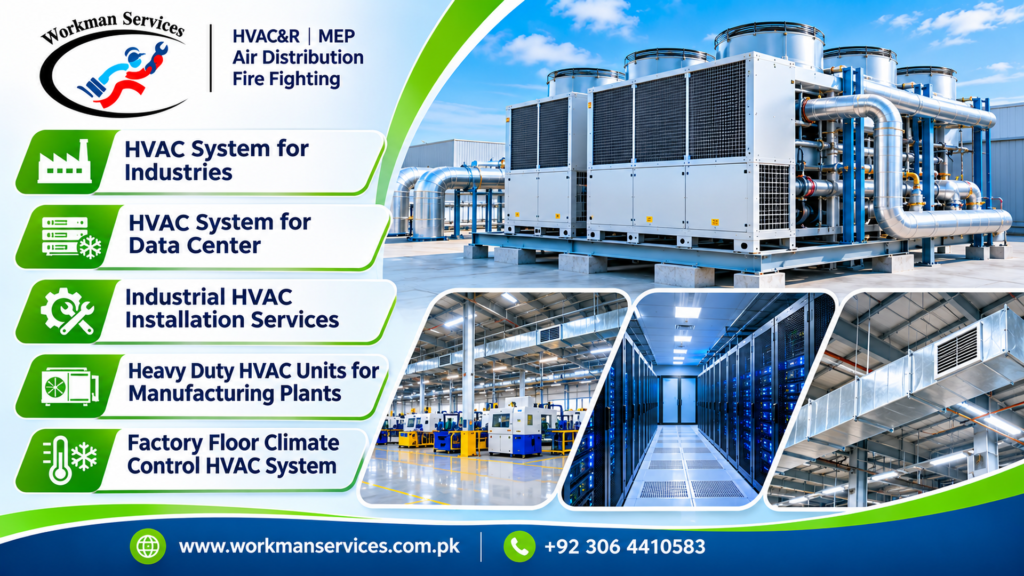
Potential solutions include chillers, AHUs, packaged HVAC units, VRF systems and industrial ventilation equipment.
The selection should consider cooling capacity, airflow, energy efficiency, maintenance requirements and available installation space.
Main HVAC Equipment Used in Industrial Buildings
| Equipment | Primary function | Common application |
|---|---|---|
| Chillers | Centralized chilled-water cooling | Large factories and industrial buildings |
| AHUs | Air conditioning and distribution | Production facilities and commercial buildings |
| FCUs | Localized cooling | Offices and individual departments |
| VRF Systems | Multi-zone temperature control | Commercial and industrial offices |
| Packaged Units | Integrated cooling solutions | Large commercial and industrial spaces |
| TFA Units | Conditioned outdoor air supply | Industrial ventilation |
| Exhaust Fans | Removal of unwanted indoor air | Manufacturing and processing areas |
| HVAC Ducting | Conditioned air distribution | Factories and warehouses |
Chiller Systems for Large Manufacturing Facilities
Chillers are commonly used in large industrial and commercial installations requiring centralized cooling.
They produce chilled water that circulates through cooling coils installed in AHUs or FCUs.
Two common configurations include:
Air-Cooled Chillers
These systems reject heat through outdoor air and can be suitable where cooling tower installation or water availability is limited.
Water-Cooled Chillers
These systems use cooling towers and water circulation to reject heat. Their suitability depends on cooling capacity, plant space, water availability and operating requirements.
Chiller selection should be based on calculated cooling demand and manufacturer performance specifications.
Air Handling Units for Industrial Applications
Air Handling Units condition and distribute air through connected ductwork.
Depending on the project requirements, an AHU can include:
- Cooling coils.
- Heating coils where required.
- Supply and return fans.
- Air filtration sections.
- Mixing chambers.
- Humidity control components.
- Monitoring and control equipment.
Proper AHU selection is important for maintaining the required airflow and pressure throughout an industrial facility.
HVAC System for Data Center in Lahore: Cooling and Environmental Control
Data centres contain servers, networking equipment, storage systems and electrical infrastructure that generate substantial heat during operation.
Unlike ordinary office spaces, server rooms require carefully controlled cooling and continuous environmental monitoring.
A properly designed hvac system for data center in Lahore should consider the following requirements:
Continuous Cooling
Server equipment can generate heat around the clock. Cooling infrastructure must be designed around continuous operating requirements.
Temperature and Humidity Monitoring
Sensors and control systems help monitor environmental conditions and identify deviations from specified operating limits.
Airflow Management
Hot-aisle and cold-aisle arrangements can help improve airflow management in suitable data centre configurations.
Cooling Redundancy
Depending on the facility’s availability requirements, engineers may design redundant cooling equipment and backup arrangements.
Equipment Protection
Cooling design should consider server manufacturer requirements, airflow distribution and maintenance accessibility.
For larger facilities, precision cooling equipment, dedicated AHUs, chilled-water systems or specialized cooling solutions may be evaluated.
A suitable hvac system for data center in Lahore should be designed according to IT equipment heat loads, rack density, redundancy requirements and the expected future expansion of the facility.
Industrial HVAC Installation Services in Gujrat
Gujrat has manufacturing businesses, engineering facilities, commercial properties and production units that require suitable mechanical and cooling infrastructure.
Industrial HVAC installation requires coordination between engineering design, equipment supply, ductwork, piping and electrical services.
Workman Services offers HVAC-related capabilities covering equipment supply, installation, air distribution and associated mechanical services.
Professional industrial hvac installation services in Gujrat should involve the following activities:
- Site inspection and project assessment.
- Review of architectural and mechanical drawings.
- Cooling load calculations.
- Equipment selection and technical evaluation.
- BOQ preparation and material planning.
- HVAC ducting and piping installation.
- Equipment positioning and connections.
- Testing and commissioning.
- Preventive maintenance planning.
When evaluating industrial hvac installation services in Gujrat, businesses should review equipment specifications, installation methodology, technical experience and maintenance arrangements.
Correct coordination between HVAC, electrical, plumbing and fire-fighting systems can also reduce installation conflicts and unnecessary project modifications.
Heavy Duty HVAC Units for Manufacturing Plants in Multan
Manufacturing plants often operate machinery for extended periods, creating significant internal heat loads.
Facilities involved in textile production, food processing, engineering, packaging and other manufacturing activities may require high-capacity cooling and ventilation arrangements.
Selecting heavy duty hvac units for manufacturing plants in Multan requires careful consideration of the following factors:
- Total production floor area.
- Machinery heat generation.
- Required cooling capacity.
- Operating hours.
- Indoor temperature requirements.
- Outdoor air ventilation.
- Equipment maintenance access.
- Electricity consumption.
- Future production expansion.
Possible equipment options include industrial chillers, AHUs, packaged units, VRF systems and dedicated ventilation equipment.
The right equipment configuration depends on the manufacturing process and building requirements.
For large production facilities, heavy duty hvac units for manufacturing plants in Multan should be selected using accurate engineering calculations rather than relying on general tonnage estimates.
Equipment efficiency, fan performance, filtration and control systems should also be evaluated before procurement.
Factory Floor Climate Control HVAC System Sahiwal
Manufacturing environments require suitable indoor conditions for machinery, production activities and employees.
A properly planned factory floor climate control hvac system Sahiwal should address temperature distribution, ventilation, machinery heat and air circulation throughout the production area.
Important design considerations include:
Uniform Air Distribution
Ductwork and supply outlets should be designed to distribute air effectively across occupied production spaces.
Heat Removal
Industrial equipment and machinery can create localized hot areas. Cooling design should account for these internal heat sources.
Ventilation
Appropriate outdoor air supply and exhaust arrangements help manage indoor air quality.
Humidity Management
Certain manufacturing processes require humidity monitoring and control according to production specifications.
Energy Efficiency
Efficient fans, suitable controls and properly insulated ductwork can help improve system performance.
A factory floor climate control hvac system Sahiwal should also account for future changes in machinery arrangement and production capacity.
Proper planning can help reduce temperature variations and provide a more suitable working environment.
Why Choose Workman Services for Industrial HVAC Projects?
Workman Services provides HVAC&R, mechanical, air distribution and fire-fighting solutions for different building categories across Pakistan.
Its website describes services and capabilities that cover several stages of mechanical project execution.
HVAC Design and Planning
Technical planning helps identify suitable cooling equipment, ventilation requirements and air distribution arrangements.
Equipment Supply
Workman Services works with HVAC equipment categories including:
- Chillers.
- Air Handling Units.
- Fan Coil Units.
- VRF systems.
- HVAC ducting.
- Fresh-air ventilation equipment.
Installation and Mechanical Coordination
Installation activities include equipment positioning, ductwork, piping, insulation and coordination with associated building services.
Testing and Commissioning
Completed installations should be inspected and tested against approved project specifications.
Maintenance Services
Preventive and corrective maintenance helps support equipment reliability and long-term operational performance.
Industrial and Commercial Project Experience
Workman Services lists commercial and retail projects including Nishat Galleria Mall, Seran Packages, Giga Mall and various retail developments.
Its HVAC&R and MEP capabilities provide a foundation for discussing industrial and commercial project requirements.
The specific technical scope, equipment and delivery arrangements should be evaluated individually for each project.
Industrial HVAC Installation Process: From Design to Commissioning
A successful installation requires an organized project execution strategy.
| Stage | Activities | Expected result |
|---|---|---|
| Site assessment | Inspect building and project requirements | Site assessment |
| Load calculation | Calculate cooling and ventilation requirements | Cooling load report |
| System design | Select equipment and distribution methods | HVAC design |
| BOQ preparation | Identify equipment and materials | Cost and quantity schedule |
| Procurement | Source approved equipment | Equipment supply |
| Installation | Complete ducting, piping and equipment installation | Installed system |
| Testing | Check airflow and equipment operation | Test results |
| Commissioning | Verify operating performance | Commissioning report |
| Maintenance | Establish servicing schedules | Maintenance plan |
Proper coordination between contractors is essential throughout the project.
How to Improve Industrial HVAC Energy Efficiency
Industrial HVAC equipment can represent a substantial part of a facility’s electricity consumption.
Businesses can improve operational efficiency through the following practices:
- Use accurate cooling load calculations.
- Select equipment according to actual operating requirements.
- Install efficient motors and fans.
- Maintain clean air filters and cooling coils.
- Inspect ductwork for leakage.
- Maintain suitable piping and duct insulation.
- Use appropriate temperature controls.
- Monitor operating pressures and temperatures.
- Schedule preventive maintenance.
- Evaluate equipment performance regularly.
Industrial facilities should also review their operating schedules to identify unnecessary cooling during unoccupied periods, where process and safety requirements allow.
Frequently Asked Questions (FAQs)
1. What HVAC system is suitable for industrial buildings?
The appropriate system depends on building size, machinery heat loads, ventilation requirements and operating schedules. Chillers, AHUs, VRF systems, packaged units and industrial ventilation equipment are common options.
2. Why do factories need specialized HVAC systems?
Factories may experience substantial heat generation from machinery and manufacturing processes. Specialized cooling and ventilation arrangements help manage indoor environmental conditions according to production requirements.
3. What is the difference between an industrial chiller and an air conditioner?
An industrial chiller produces chilled water for connected cooling coils, whereas a conventional air conditioner generally provides cooling through a direct refrigerant-based system. Their applications depend on building size and cooling requirements.
4. What HVAC equipment is used in data centres?
Data centres may use precision cooling equipment, specialized AHUs, chillers, dedicated cooling units and environmental monitoring systems. Equipment selection depends on IT heat loads and redundancy requirements.
5. How can industrial buildings reduce HVAC electricity costs?
Businesses can improve efficiency through correct equipment sizing, efficient motors, variable-speed controls, insulation, clean filters and regular maintenance.
6. Does Workman Services provide HVAC installation?
Workman Services lists HVAC equipment supply, installation, ducting, testing, commissioning and maintenance among its capabilities. Contact the company to discuss the scope of a specific project.
7. What information is required for an industrial HVAC quotation?
Useful information includes building drawings, covered area, ceiling height, machinery details, operating schedules, cooling requirements, project location and technical specifications.
8. How often should industrial HVAC equipment be maintained?
Maintenance frequency depends on equipment type, operating hours, environmental conditions and manufacturer recommendations. High-use industrial equipment generally requires a planned preventive maintenance programme.
9. Can centralized HVAC systems serve multiple production departments?
Yes. A centralized cooling plant can serve multiple departments through separate distribution zones. Each department’s cooling load, airflow and ventilation requirements must be evaluated during design.
10. How can I contact Workman Services?
Visit the official website or contact the company directly to discuss HVAC design, equipment supply, installation and maintenance requirements.
Conclusion: Professional Industrial HVAC Solutions Across Pakistan
Industrial HVAC systems are an important investment for manufacturing facilities, production plants, warehouses and commercial developments. Proper cooling calculations, equipment selection, ventilation planning, ductwork installation and maintenance contribute to reliable building operations.
Whether you are developing a factory, upgrading a production facility or planning specialized cooling infrastructure, professional HVAC engineering can help you select an appropriate solution.
Workman Services provides HVAC&R, MEP, air distribution, equipment supply, installation, testing, commissioning and maintenance capabilities for different project requirements across Pakistan.
For businesses planning an hvac system for industries in Rahim Yar Khan, the company can discuss project drawings, technical specifications and equipment requirements to help establish a suitable project scope.
Contact Workman Services
Website: https://workmanservices.com.pk/
Email: info@workmanservices.com.pk
Phone: +92 306 4410583
Address: M1, Bara Tower, 36 Queens Road, Abid Market, Lahore, Pakistan.
Contact Workman Services to discuss your next industrial HVAC project.