
Your Guide to Finding the Best AHU Services

Your Guide to Finding the Best AHU Services Finding reliable climate control solutions for large residential, commercial, and industrial spaces requires expertise and precision. Since 2006, Workman Services has led the HVAC industry, providing top-notch cooling, heating, and ventilation systems. When managing the air quality and temperature of massive facilities, the core of your setup relies on a powerful system. If you want to maximize energy efficiency and maintain perfect indoor air quality, you need the Best AHU Services available. This guide covers everything you must know about these systems, from choosing the right equipment to proper maintenance. Understanding the Heart of Your HVAC System At the center of any large-scale heating, ventilation, and air conditioning setup is the equipment responsible for circulating air. An air handler unit takes in outside air, conditions it, and distributes it throughout a building. This process ensures that fresh, clean, and perfectly cooled or heated air reaches every room. Without a properly functioning system, buildings suffer from poor ventilation, inconsistent temperatures, and skyrocketing energy bills. That is why facilities managers prioritize finding the Best AHU Services to design, install, and maintain their equipment. Proper installation ensures your equipment operates at peak performance for years to come. Workman Services brings nearly two decades of experience to the table. We understand the unique demands of apartments, luxury villas, office spaces, IT companies, automotive showrooms, and massive manufacturing units. By combining skilled engineering with quality brands, we deliver solutions that save you money and guarantee 100% client satisfaction. Why Professional Installation Matters Installing heavy-duty climate control machinery is not a simple task. It requires meticulous planning, precise coordination, and flawless project execution. When you hire professionals Dealing in AHU, you ensure that your system integrates perfectly with your existing ductwork, chillers, and ventilation networks. A poorly installed air handler unit will constantly struggle to push air through ducts, leading to mechanical wear and tear. This reduces the lifespan of your equipment and increases your monthly utility costs. Choosing the Best AHU Services prevents these issues. Our certified technicians calculate the exact airflow requirements for your specific space, ensuring you get a system that fits your needs perfectly. Key Benefits of Expert Installation Energy Efficiency: Properly calibrated systems use less electricity. Improved Air Quality: Expertly installed filters and fresh air intake systems remove pollutants. Consistent Comfort: No more hot or cold spots in your building. Longer Lifespan: Correct installation prevents premature mechanical failures. Comprehensive Maintenance and Support Even the highest quality systems require regular check-ups. Routine maintenance keeps your machinery running smoothly and prevents sudden breakdowns. When you invest in professional AHU Services, technicians inspect every component, from the blower fan and cooling coils to the filters and dampers. Ignoring maintenance leads to dirty coils, clogged filters, and failing motors. These issues force the system to work harder, draining energy and eventually causing a complete shutdown. By partnering with experts Dealing in AHU, you receive scheduled inspections that catch minor problems before they turn into expensive repairs. Workman Services provides unmatched customer support. Our technicians arrive on time, diagnose issues quickly, and perform thorough maintenance to keep your environment comfortable and safe. We help you avoid costly replacements by extending the life of your equipment through dedicated care. Comparing Different Types of Systems Different buildings require different air distribution strategies. Understanding the options available helps you make informed decisions for your property. Below is a comparison table outlining the common types of systems used in commercial and industrial applications. System Type Best Application Key Features Energy Efficiency Draw-Through Commercial offices, retail spaces Pulls air through the heating/cooling coils before distributing it. High Blow-Through Industrial plants, large warehouses Pushes air through the coils. Excellent for systems requiring high static pressure. Medium Make-Up Air Kitchens, laboratories, hospitals Brings in 100% outside air to replace exhausted air. Ensures high indoor air quality. Varies by design Rooftop Unit Retail, mid-sized commercial Compact, all-in-one system mounted on the roof to save indoor space. High Selecting the right configuration is crucial. When you rely on the Best AHU Services, engineers evaluate your building’s architecture, occupancy levels, and ventilation needs to recommend the perfect match. Upgrading Your Climate Control Infrastructure Older buildings often struggle with outdated ventilation equipment. Upgrading your infrastructure provides immediate benefits, including drastic reductions in energy consumption. Modern systems feature variable speed drives, advanced filtration, and smart controls that adapt to real-time temperature changes. If your current setup constantly requires repairs, it might be time for a replacement. Consult with a team highly experienced in AHU Services to evaluate your existing machinery. Sometimes, retrofitting new components into an older framework provides a cost-effective solution. Other times, a full replacement is the smartest financial move. Workman Services handles everything from the initial planning stages to final execution. We coordinate seamlessly with your facility managers to ensure minimal disruption to your daily operations during the upgrade process. The Role of Fresh Air in Building Safety Air distribution does more than just regulate temperature; it keeps occupants safe. In environments like hospitals, resorts, and manufacturing units, proper ventilation removes airborne contaminants and supplies fresh oxygen. An advanced air handler unit manages this delicate balance. It filters out dust, allergens, and harmful particles while controlling indoor humidity levels. High humidity breeds mold, while low humidity causes discomfort. A well-maintained AHU prevents both extremes, creating a healthy environment for employees, customers, and residents. Because life safety is paramount, Workman Services also integrates climate control with comprehensive fire fighting solutions. Proper airflow management is critical during emergencies to prevent the spread of smoke. Our integrated approach ensures your building meets all safety codes and provides maximum protection. Partnering with Workman Services Since our establishment, we have completed hundreds of successful projects across Pakistan and the UAE. Our prestigious clients trust us because we only work with quality brands and employ certified, highly skilled technicians. When you need a contractor Dealing in AHU, you want a partner who values your time and budget. We deliver affordable, long-lasting solutions
The Difference Between VRF and AHU for Modern Buildings
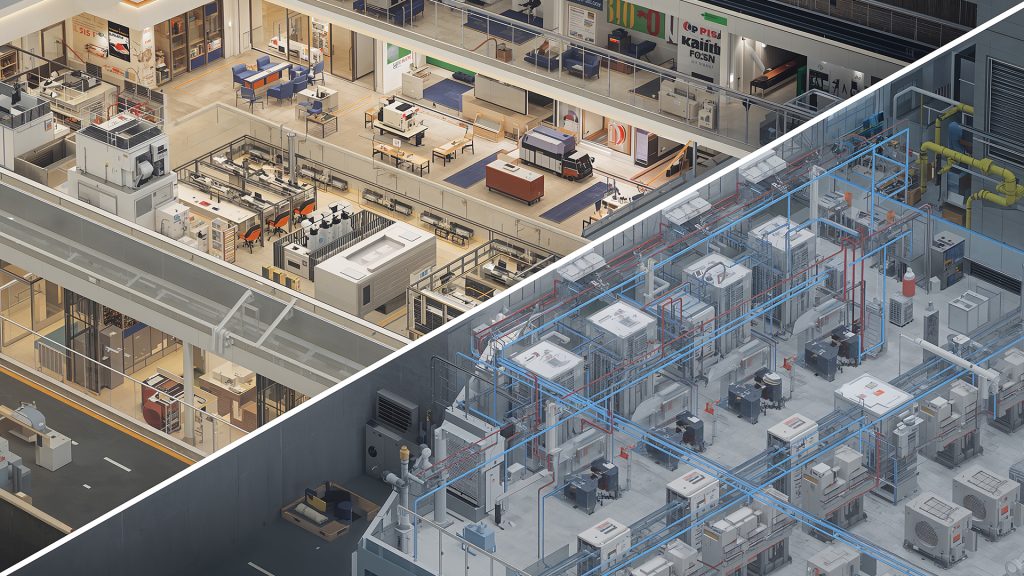
The Difference Between VRF and AHU for Modern Buildings Choosing the right heating, ventilation, and air conditioning (HVAC) system is one of the most critical decisions for any large-scale building project. Whether for a bustling shopping mall, a high-tech industrial facility, or a critical-care hospital, the HVAC system determines occupant comfort, operational efficiency, and long-term energy costs. At Workman Services, with over 18 years of experience in the HVAC & R industry, we guide our clients through this complex decision. Two of the most common solutions for large spaces are Variable Refrigerant Flow (VRF) and Air Handling Unit (AHU) systems. But what is the difference between VRF and AHU? Understanding this distinction is key to selecting the ideal solution for your specific needs. While both systems deliver effective climate control, they operate on fundamentally different principles. An AHU-based system is a more traditional approach, using a central unit to condition air and distribute it through extensive ductwork. In contrast, a VRF system offers a more modern, decentralized approach, using refrigerant lines to connect a single outdoor unit to multiple indoor units. This guide will explore the core concepts of both systems, break down their key differences, and explain which applications they are best suited for. By the end, you’ll have a clear understanding of the difference between VRF and AHU and be better equipped to choose the right system for your commercial, industrial, or residential project in Pakistan. What is an Air Handling Unit (AHU)? An Air Handling Unit, or AHU, is a cornerstone of traditional centralized HVAC systems. Think of it as the “lungs” of a building. The AHU is a large metal box containing a blower, heating and cooling elements (coils), filters, sound attenuators, and dampers. Its primary function is to collect air from outside and inside the building, filter it, condition it to the desired temperature and humidity, and then distribute it throughout the space via a network of ducts. AHUs are often paired with chillers (which supply cold water to the cooling coil) or boilers (which supply hot water or steam to the heating coil). This combination allows a single, powerful system to serve an entire building, from a multi-story office block to a large factory floor. The simplicity and power of AHUs have made them a go-to solution for decades, especially for large, open spaces where a uniform temperature is required. These systems are robust and highly effective at moving large volumes of air, making them a common component in an HVAC system for industries that require consistent environmental conditions. What is a Variable Refrigerant Flow (VRF) System? Variable Refrigerant Flow, or VRF, represents one of the most significant advancements in the latest HVAC technology. Unlike the centralized, air-based approach of an AHU, a VRF system is a refrigerant-based, multi-split system. It consists of a single outdoor condensing unit connected via refrigerant piping to multiple indoor units, which can be of various types (e.g., wall-mounted, ceiling cassette, or concealed ducted units). The “variable” in its name is the key to its efficiency. The system can vary the amount of refrigerant flowing to each individual indoor unit, allowing for precise temperature control in different zones. Some advanced VRF systems can even provide simultaneous heating and cooling, where heat extracted from a cooling zone is redirected to a zone that requires heating. This heat recovery feature makes VRF air conditioning incredibly energy-efficient. Because VRF systems use small refrigerant pipes instead of bulky ductwork, they offer greater architectural flexibility and are easier to retrofit into existing buildings. This modularity and zoning capability make them an increasingly popular choice for applications where individual comfort control is a priority. Key Differences: VRF vs. AHU To truly grasp the difference between VRF and AHU, it helps to compare them across several key factors. Both systems have their place, but their suitability depends entirely on the project’s requirements, budget, and long-term goals. Feature Air Handling Unit (AHU) System Variable Refrigerant Flow (VRF) System System Type Centralized, air-based system. Uses ductwork to distribute conditioned air. Decentralized, refrigerant-based system. Uses pipes to send refrigerant to multiple indoor units. Zoning Limited zoning capabilities. Best for uniform temperature across large, open spaces. Superior individual zone control. Each indoor unit can have a different setpoint. Energy Efficiency Generally less efficient due to thermal losses in ductwork and constant air volume. Highly energy-efficient due to variable speed compressors, zoning, and heat recovery options. Installation Requires significant space for the AHU and extensive ductwork, which can be complex to install. Less invasive installation with smaller refrigerant piping. Ideal for retrofitting older buildings. Flexibility Less flexible. Difficult to modify once the ductwork is in place. Highly flexible and scalable. Easy to add or reconfigure indoor units as needs change. Maintenance Centralized maintenance at the AHU. Ductwork may require periodic cleaning. Requires specialized technicians to service multiple indoor and outdoor units and refrigerant lines. Upfront Cost Can have a lower initial equipment cost, but installation can be expensive. Higher initial equipment cost, but often lower installation and long-term operational costs. Ventilation Excellent for introducing fresh air, as it is integrated into the central unit. Requires a separate dedicated outdoor air system (DOAS) to introduce fresh air. Which System is Right for Your Application? Now that we understand the technical difference between VRF and AHU, let’s apply this knowledge to real-world scenarios that we at Workman Services encounter daily. HVAC for Malls and Retail Spaces Shopping malls present a unique challenge with their mix of large open atriums, smaller individual retail stores, and food courts. An effective HVAC for malls needs to be both powerful and flexible. AHU Approach: A traditional approach might use large AHUs to cool the main corridors and open spaces. While effective for these areas, it offers little control for individual tenants, who often have to install their own supplementary systems. VRF Approach: A VRF air conditioning system is often a superior solution for modern malls. It allows each retail unit to control its own temperature, catering