
Is Your Building Getting the Powerful Cooling It Deserves? Meet Air Conditioner Chillers!

Is Your Building Getting the Powerful Cooling It Deserves? Meet Air Conditioner Chillers! Cool, fresh, and comfortable air transforms every building into a place people love to be! Air conditioner chillers are one of the smartest, most reliable ways to deliver that comfort — and the right partner makes the whole experience easy and exciting. Here’s the quick answer: air conditioner chillers cool water and circulate it through a building to remove heat and keep large spaces comfortable all day long. You’ll find them in offices, hospitals, malls, hotels, factories, and IT centers — anywhere steady, powerful cooling matters most. They’re the go-to choice when you need dependable comfort across many rooms or entire floors! Since 2006, Workman Services has grown into a trusted provider businesses count on across Pakistan and the UAE. We handle everything under one roof — design, supply, installation, testing, commissioning, and maintenance. One expert team, one point of contact, and total peace of mind! In this guide, you’ll discover how chiller cooling works, how it beats standard AC, where it shines brightest, and how to choose the perfect partner. Let’s dive in! Ever Wondered How a Chiller Actually Keeps Your Building Cool? Chiller cooling is simple, smart, and wonderfully effective! It cools water and sends it through your building to soak up heat, then releases that heat safely away from your space. Here’s the easy step-by-step: Refrigerant absorbs heat from return water inside the evaporator. The compressor raises the refrigerant’s pressure and temperature. The condenser releases that heat — either to outdoor air or through a cooling tower. The now-cooled water flows back through the building to keep every zone comfortable. An air cooled chiller rejects heat using outdoor air and fans, so it needs no cooling tower and far less water. That makes it a fantastic fit for dry regions and tight sites! A water cooled unit uses a tower for very large, steady loads. Both keep your building beautifully cool — the right choice depends on your site and needs. Standard AC or Chiller Cooling — Which One Does Your Building Really Need? Both options cool your space wonderfully, but they work at very different scales! Understanding the difference is the key to picking the perfect system. A standard split or package unit cools one room or a small area with direct refrigerant — simple and great for compact spaces. A chiller ac system, by contrast, cools water and distributes it through pipes to serve many rooms, floors, or even whole buildings at once. That’s real power and consistency! Here’s why so many facilities love chillers: Scale: One central system cools huge areas efficiently. Consistency: Every zone gets steady, even comfort. Efficiency: Central cooling often runs more economically at large loads. Control: Smart automation fine-tunes comfort room by room. When you need comfort across a big footprint, a chiller ac system delivers dependable results day after day! Where Do Air Conditioner Chillers Perform Best? Here Are the Top Applications! Air conditioner chillers keep all kinds of spaces cool, fresh, and productive! From busy hospitals to bustling malls, they deliver steady performance around the clock. Here’s where they truly shine: Office buildings and IT companies: Reliable, even cooling for people and sensitive equipment. Hospitals and healthcare: Steady temperatures for patient comfort and critical areas. Retail and shopping malls: Cool, welcoming air that keeps shoppers happy. Manufacturing units: Precise process cooling that protects products and machines. Hotels and resorts: Consistent comfort in rooms, lobbies, and common areas. Imagine a growing hospital in Lahore that needs powerful cooling every hour of every day. A well-designed cooled chiller system delivers it reliably, keeping patients and staff comfortable and safe. That’s dependable cooling exactly where it counts most! Your Chiller Is Only as Good as the System Around It — Here’s Why! A chiller alone can’t do it all! Great cooling comes from great teamwork between every part of the system. When these elements are matched with care, everything runs quietly, saves energy, and lasts for years. Here’s what makes the whole system sing: Chilled water piping: Carries cooled water to every zone with minimal losses. Pumps: Move water at the right flow and pressure for even, steady comfort. Controls: Keep everything efficient, automated, and easy to manage. Ventilation and air distribution: Deliver that cool comfort into every room. A properly designed air cooled chiller system links all of these seamlessly. When they’re mismatched, you get noise, waste, and hot or cold spots. But when they’re planned together as one, the result is smooth, efficient, and reliable cooling! That’s why an integrated approach always wins. Ready to Choose a Chiller Partner? Here’s Your Easy Checklist! Picking the right partner is the secret to happy, efficient cooling! The best supplier does far more than deliver equipment — they guide you from the first idea all the way to long-term care. Here’s your easy checklist: Look for full-service capability. Choose a partner offering design, supply, installation, testing, commissioning, and maintenance. Check sector experience. Make sure they’ve served buildings like yours — offices, hospitals, factories, or retail. Ask about quality brands. Reliable equipment means better performance and fewer breakdowns. Confirm certified technicians. Skilled experts ensure your system is installed and tested properly. Insist on correct sizing. A proper load calculation avoids waste and strain. Value long-term support. Ongoing maintenance keeps your system efficient for years. A great partner also helps you weigh an air cooled chiller against a water cooled option, matching the system to your site, budget, and goals. Tick every box on this list and you get expertise, reliability, and real peace of mind! Compare Your Cooling Options in One Simple Table! Great performance comes from great teamwork between systems! Here’s a quick look at the main cooling options and why each one matters. Cooling Option Function Best Use Case Why It Matters Air Cooled Chiller Cools water using outdoor air and fans Sites with limited water or roof space Low water use and simpler maintenance Water Cooled
Your Trusted Air Cooled Chiller Supplier and Water Cooled Chiller Supplier Pakistan
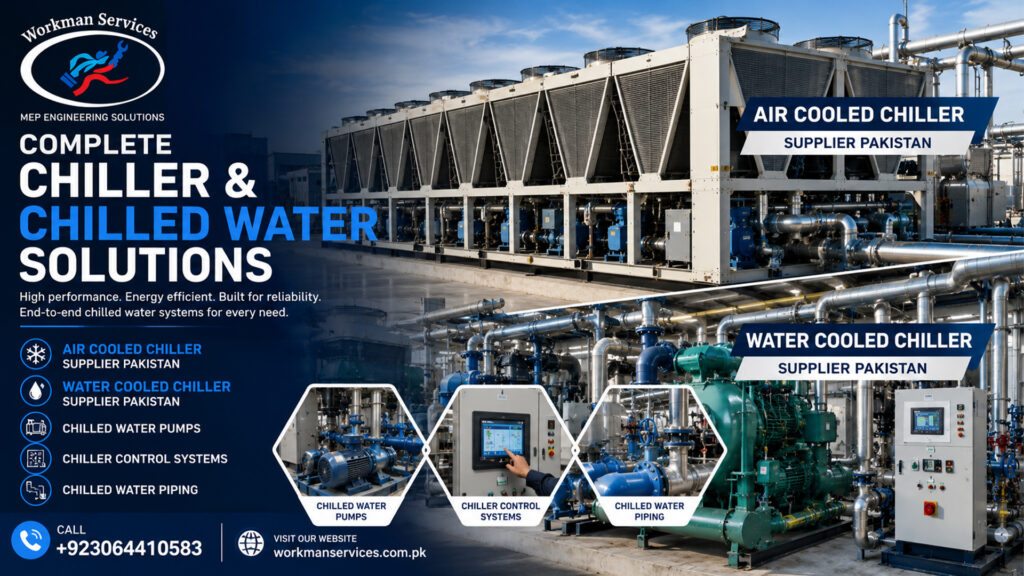
Your Trusted Air Cooled Chiller Supplier Pakistan for Reliable Cooling Cooling your building shouldn’t be complicated! An air cooled chiller is one of the easiest, smartest ways to keep large spaces comfortable and productive. And finding the right partner makes all the difference. Here’s the quick answer: an air cooled chiller is a cooling system that removes heat from water using outdoor air, then circulates that chilled water to cool your building. It skips the cooling tower, which means less water use and simpler upkeep! You choose it when water is scarce, roof space is limited, or you want lower maintenance. Since 2006, Workman Services has grown into a trusted Air Cooled Chiller Supplier Pakistan businesses rely on for dependable comfort. We handle everything under one roof — design, supply, installation, testing, commissioning, and maintenance. That means one team, one point of contact, and total peace of mind! In this guide, you’ll learn how these chillers work, where they shine, how to pick the right size, and why the whole system matters. Let’s break it all down together! What Is an Air Cooled Chiller and How Does It Work? An air cooled chiller cools water and sends it through your building to absorb heat. Fans blow outdoor air across the condenser coils to release that heat outside. Simple, effective, and reliable! Here’s the easy step-by-step: Refrigerant absorbs heat from the return water inside the evaporator. The compressor raises the refrigerant’s pressure and temperature. The condenser coils release heat as fans push outdoor air across them. The now-cooled water flows back through the building to keep it comfortable. The best part? There’s no cooling tower and no constant water top-ups. That makes an air cooled system a fantastic fit for regions where water is precious. A water cooled system works differently, using a cooling tower to reject heat — great for very large loads, but it needs more water and space. Air Cooled vs. Water Cooled: A Quick Note Both systems cool beautifully! The choice depends on your building, budget, and site. If you want lower water use and easier upkeep, air cooled is your friend. If you run a massive facility with high, steady loads, a Water Cooled Chiller Supplier Pakistan can help you weigh the water cooled route. Workman Services supplies both, so you always get the right match! Key Applications in Commercial and Industrial Facilities Air cooled chillers keep all kinds of spaces cool, safe, and comfortable! From busy offices to bustling factories, they deliver steady performance day after day. Here’s where they truly shine: Office buildings and IT companies: Reliable, quiet cooling for people and sensitive equipment. Hospitals and healthcare: Consistent temperatures for patient comfort and critical rooms. Retail and showrooms: Cool, welcoming spaces that keep shoppers happy. Manufacturing units: Precise process cooling that protects products and machines. Hotels and resorts: Comfortable rooms and common areas, all year round. Imagine a growing manufacturing plant in Lahore that needs steady process cooling. An air cooled chiller keeps production humming without the hassle of a water tower. That’s dependable comfort where it counts most! The Benefits That Make Air Cooled Chillers a Smart Choice There’s so much to love about these systems! They’re practical, efficient, and easy to live with. Lower water use: No cooling tower means big water savings — perfect for dry regions. Simpler maintenance: Fewer components to manage means less downtime and stress. Flexible placement: Roof or ground level, indoor or outdoor, they fit tight sites well. Faster installation: No tower plumbing often means a quicker, cleaner setup. Long service life: With quality brands and proper care, they perform for years! Choosing a reliable partner protects every one of these benefits. That’s exactly why so many facilities pick Workman Services for their cooling projects! How to Select the Right Capacity and System Layout from Your Air Cooled Chiller Supplier Pakistan Sizing your chiller correctly is the secret to happy, efficient cooling! Too small and it strains; too big and you waste energy. The right Air Cooled Chiller Supplier Pakistan helps you get it just right. Here’s your easy checklist: Calculate the cooling load. Consider building size, occupancy, equipment heat, and climate. Plan the layout. Map airflow, service access, and where the unit will sit. Think about redundancy. Multiple smaller units can keep you cool if one needs service. Match components. Pumps, controls, and piping must work together smoothly. Plan for growth. Leave room to expand as your facility grows! Why the Whole System Matters, Not Just the Chiller A chiller is only as good as the system around it! Chilled Water Pumps move cooled water through the building at the right flow and pressure. Chiller Control Systems keep everything running efficiently and safely. And well-designed Chilled Water Piping delivers that cool comfort to every zone. When these parts are matched with care, your system runs quietly, saves energy, and lasts longer. When they’re mismatched, you get noise, waste, and headaches. That’s why an integrated approach wins every time! Understanding the Core System Components Great cooling comes from great teamwork between parts! Here’s a simple look at the key elements and why each one matters. System Element Role Why It Matters Best Use Case Air Cooled Chiller Cools water using outdoor air Delivers reliable cooling with low water use Sites with limited water or roof space Chilled Water Pumps Circulate chilled water through the building Ensure steady flow and even cooling everywhere Multi-zone offices, hospitals, and factories Chiller Control Systems Manage operation and efficiency Optimize energy use and prevent faults Facilities needing smart, automated control Chilled Water Piping Carries cooled water to each zone Reduces losses and keeps temperatures stable Large buildings with many cooling areas Cooling Coils / FCUs Transfer cool air into rooms Deliver comfort directly to occupants Offices, retail, and guest rooms This is your system at a glance — clear, connected, and built to perform! Why Workman Services Is a Strong Partner in Pakistan We make cooling easy from start to finish!
A Complete Guide to Chiller Equipment and How the Main Types Compare

📞 Call us today: +92 306 4410583 | ✉️ info@workmanservices.com.pk A Complete Guide to Chiller Equipment and How the Main Types Compare Choosing a cooling system for a large building can feel overwhelming. There are different machines, different working methods, and very different price tags. The good news? Once you understand how each option works, the right choice becomes clear. This guide breaks it all down in plain language. We’ll explain what chiller equipment is, how the four main types differ, and which one fits your building or industry best. By the end, you’ll know exactly what to ask before you invest. Workman Services has delivered HVAC & R projects since 2006. From our base in Lahore, we serve residential, commercial, and industrial clients across Pakistan and the UAE. Let’s get into it. What Is Chillers Equipment and How Does It Work? Chiller equipment is a cooling machine that lowers the temperature of water, then circulates that cold water through a building to remove heat. Instead of cooling the air directly at every point, the system moves cool water to air handling units and fan coil units, which then spread comfort across the space. Here’s the basic cycle in simple steps: The chiller cools water using a refrigeration process. Pumps push the chilled water through insulated pipes. Air handlers and fan coil units use that water to cool the air. Warm water returns to the chiller, and the cycle repeats. This approach is efficient, scalable, and well suited to buildings where ordinary split units simply can’t keep up. Offices, malls, hospitals, and factories all rely on this method to stay cool without runaway energy bills. The four types you’ll meet most often are air cooled chillers, water cooled chillers, screw chillers, and scroll chillers. They split into two families: how they reject heat, and how their compressor works. Understanding both helps you pick with confidence. The Main Types of Chiller Equipment Explained Not every building needs the same machine. The right pick depends on your cooling load, your site, and your budget. Below, we walk through each of the four main types so you can see how they differ. How Heat Rejection Shapes Your Chiller Equipment Choice The first big difference is how a chiller gets rid of heat. This single factor affects installation, efficiency, and maintenance more than almost anything else. Air cooled chillers reject heat straight into the surrounding air using fans. Because they don’t need a cooling tower or extra water supply, they’re simpler to install and easier to look after. They work well outdoors and suit sites where water is limited or space for a tower isn’t available. Water cooled chillers take a different path. They use a cooling tower and a water loop to reject heat, which makes them more efficient under very large or steady loads. They usually last longer and run quieter, but they need more space and regular care of the cooling tower and water quality. In short: air cooled chillers win on simplicity, while water cooled chillers win on efficiency at scale. Your building size and site conditions decide which one makes sense. How Compressor Type Affects Performance The second big difference is the compressor, the heart of the machine. This is where screw chillers and scroll chillers come in. Screw chillers use a rotary screw compressor. They handle medium to high cooling loads smoothly and perform reliably under heavy, continuous use. That makes them a favourite for factories, processing plants, and large commercial buildings that run for long hours. Scroll chillers use a scroll compressor, which is compact, quiet, and very reliable. They shine in smaller commercial spaces where the cooling load is lower. Scrolls chillers are also easy to maintain and cost less upfront, so they’re a smart pick for offices, clinics, and small retail units. It’s worth noting these categories overlap. An air cooled chiller can use a scroll or screw compressor, and so can a water cooled model. The best chiller equipment for you combines the right heat rejection method with the right compressor for your load. Comparing the Four Chiller Types Side by Side Sometimes a table says it best. The comparison below sums up where each option fits, so you can weigh them quickly before a deeper conversation with an engineer. Chiller type Best for Cooling capacity Efficiency Maintenance Upfront cost Air cooled chillers Offices, retail, mid-size buildings, limited-water sites Low to medium Good Simple, fewer parts Lower Water cooled chillers Malls, hospitals, large complexes, district cooling High Excellent at scale Cooling tower and water care needed Higher Screw chillers Factories, processing plants, large commercial Medium to high Very good under load Moderate Medium Scroll chillers Small offices, clinics, small retail Low Good Easy and reliable Lower The takeaway is simple: match the machine to your real needs, not just the lowest price. A well-chosen system saves money for years through lower energy bills and fewer breakdowns. Which Chiller Equipment Suits Your Building or Industry? Now that you know the types, let’s match them to real situations. This is where the choice becomes practical. Mid-size offices and retail: Air cooled chillers are often ideal. They’re simple, cost-effective, and don’t need a water tower. Large malls, hospitals, and complexes: Water cooled chillers pay off here. Their efficiency at scale keeps running costs down across huge cooling loads. Factories and processing plants: Screw chillers handle heavy, continuous loads and keep production temperatures steady and safe. Small clinics, shops, and compact offices: Scrolls chillers offer quiet, reliable cooling with lower upfront and maintenance costs. Sites with limited water or space: Air cooled chillers again make the most sense, since they skip the cooling tower entirely. For growing facilities, it’s also smart to plan ahead. A system sized only for today’s load may struggle after an expansion. A proper assessment looks at both current and future needs. Why Choose Workman Services for Your Chiller Equipment Picking a cooling partner is really about trust. You’re investing in a machine
Chiller Installation: A Complete Guide for Buildings and Facilities

📞 Call us today: +92 306 4410583 | ✉️ info@workmanservices.com.pk Chiller Installation: A Complete Guide for Buildings and Facilities A cooling system is only as good as the way it’s put in. You can buy the best equipment on the market, but if it’s installed poorly, you’ll face leaks, uneven cooling, and energy bills that never seem to make sense. That’s why the installation stage deserves your full attention from the very start. This guide walks you through the whole process, from planning to handover. Whether you run an office, a hospital, a factory, or a retail space, you’ll learn what a professional setup involves and how to avoid the mistakes that cost the most. Here’s what you’ll learn: What a proper installation process actually includes How testing, commissioning, and maintenance fit together How to choose a team you can trust Let’s get into it. Why Professional Chiller Installation Matters More Than the Equipment Your cooling system is one of the largest investments in any big building. It runs for a decade or more, so how it’s set up shapes your comfort and your bills for years. A rushed job creates problems you’ll pay for again and again. Workman Services has delivered HVAC & R projects since 2006. From our base in Lahore, we serve residential, commercial, and industrial clients across Pakistan and the UAE. That experience has taught us a clear lesson: careful Chiller Installation is what separates a system that runs smoothly for years from one that struggles from day one. Good setup starts long before anyone lifts a wrench. It begins with an accurate load calculation, a smart system design, and the right equipment for your space. Skip those steps and even top-tier hardware will underperform. The Complete Chiller Installation Process, Step by Step A well-run project follows a clear sequence. Each stage builds on the one before it, so nothing gets missed and quality stays consistent. Here’s how a proper Chiller Installation unfolds from first visit to final handover. Site assessment. We measure the cooling load and study your building layout. System design. Our engineers select the right unit, pipe network, and controls. Equipment supply. We source hardware from trusted, top-rated brands. Physical installation. Certified technicians fit the unit, pumps, and distribution network. Testing and commissioning. We confirm the system runs safely and efficiently. Handover and maintenance plan. We hand over a working system with a service schedule. Each step matters, and skipping any one of them creates weak points later. The table below shows how each stage connects to a real outcome for your building. Stage What happens Outcome for your building Site assessment Load calculation and layout study Correct sizing, no wasted capacity System design Unit, pipework, and control selection Efficient, balanced cooling Equipment supply Sourcing from trusted brands Reliable, long-lasting hardware Physical installation Fitting units, pumps, and pipes Clean, leak-free setup Testing and commissioning Safety and performance checks Confidence the system works Handover Documentation and service plan Long-term peace of mind When each phase is handled with care, the whole system lasts longer and costs less to run. Getting Chiller Supply and Placement Right Before installation begins, the right equipment has to arrive on site. Good chiller supply & installation means matching the hardware to your real cooling load, not just picking the cheapest option or the biggest unit on the shelf. Placement matters too. A unit needs proper clearance for airflow, service access, and safe electrical connections. Our team plans the exact position during the design stage, so the chiller supply & installation runs smoothly without last-minute surprises on site. We handle chiller supply & installation for apartments, luxury villas, offices, IT companies, automotive showrooms, manufacturing units, resorts, hospitals, and retail spaces. Because we manage chiller supply & installation in-house, you get one accountable team from the first quote to the final switch-on. Why In-House Chiller Installation Beats Split Contractors Juggling separate suppliers, installers, and testers is stressful and risky. Gaps between contractors are where problems hide. A single team running your Chiller Installation keeps quality consistent and gives you one point of contact when questions come up. Chiller Testing & Commissioning: Proving the System Works Fitting the equipment is only part of the job. Before a system goes live, it needs proper Chiller Testing & Commissioning to confirm it runs safely and efficiently. This is the stage that turns a newly installed unit into a trusted, working system. Chiller Testing & Commissioning checks the details that make or break performance: Refrigerant charge and leak detection Water flow rates and pressure balance Electrical connections and safety cut-outs Control settings and sensor accuracy Temperature output under real load conditions Skipping this step is a common cause of early failures. Thorough Chiller Testing & Commissioning catches small faults before they grow into expensive breakdowns, and it confirms your system delivers the cooling you paid for. We document every result during Chiller Testing & Commissioning, so you have a clear record of how the system performed at handover. That paperwork also makes future servicing faster and easier. Chiller Maintenance: Protecting Your Investment After Handover A great install is the start, not the finish. Regular Chiller Maintenance keeps your system efficient, reliable, and ready for the hottest days of the year. Without it, even a perfect setup slowly loses performance. A solid Chiller Maintenance plan covers the essentials: Cleaning condenser and evaporator coils Checking refrigerant levels and looking for leaks Inspecting pumps, motors, and bearings Testing controls, sensors, and safety devices Monitoring water quality to prevent scaling and corrosion Planned Chiller Maintenance costs far less than emergency repairs. A well-tuned system uses less energy, breaks down less often, and lasts longer than one that’s left alone. We build a Chiller Maintenance schedule around your equipment type, running hours, and site conditions. That way, small issues get caught early, before they turn into big, costly problems. Sectors We Serve Across Pakistan and UAE Every building has different cooling needs, and we tailor each project to fit.
Chiller Maintenance Pakistan: A Complete Guide to Longer-Lasting Cooling

📞 Call us today: +92 306 4410583 | ✉️ info@workmanservices.com.pk Chiller Maintenance Pakistan: A Complete Guide to Longer-Lasting Cooling A chiller running smoothly is easy to ignore. A chiller breaking down in the middle of summer is impossible to ignore, and often expensive to fix. The difference between the two usually comes down to one thing: regular care. For any factory, hospital, mall, or office, the cooling system is a major investment. Looking after it properly keeps your building comfortable, protects your equipment, and controls your energy bills for years. This guide explains what good maintenance involves, when to repair versus replace, and how to choose a team you can trust. Here’s what you’ll learn: What proper chiller care actually includes When to overhaul, replace, or upgrade your system How to pick a reliable service partner Answers to the questions facility managers ask most Let’s dig in. Why Chiller Maintenance Pakistan Deserves Your Attention Your chiller is one of the biggest energy users in the whole building. When it drifts out of tune, it works harder, uses more power, and slowly wears itself out. You often don’t notice until the bills climb or the cooling fades on the hottest day of the year. Workman Services has delivered HVAC & R projects since 2006. From our base in Lahore, we support residential, commercial, and industrial clients across Pakistan and the UAE. That experience has taught us a simple truth: a well-maintained chiller lasts far longer and costs far less to run than one that’s left alone. Skipping service to save money almost always backfires. Small problems grow into big ones, and an emergency repair costs many times more than routine care. Planned Chiller Maintenance Pakistan protects your investment and keeps your facility cool when you need it most. What Good Chiller Maintenance Pakistan Actually Includes Not all servicing is equal. A quick look and a wipe-down isn’t real maintenance. Proper care follows a checklist that keeps every part of the system healthy. Routine Tasks in a Chiller Maintenance Pakistan Program A thorough service visit should always cover the basics that keep your chiller efficient and safe: Checking refrigerant levels and looking for leaks Cleaning condenser and evaporator coils Inspecting pumps, motors, and bearings Testing controls, sensors, and safety cut-outs Checking water quality to prevent scaling and corrosion Reviewing electrical connections and tightening where needed Each of these steps protects efficiency and prevents the kind of hidden wear that leads to sudden failure. A structured Chiller Maintenance Pakistan plan schedules these checks before problems appear, not after. Deep Servicing Through Chiller Maintenance & Overhauling Over time, even a well-cared-for chiller needs a deeper reset. That’s where Chiller Maintenance & Overhauling comes in. An overhaul strips the system back, cleans and inspects major components, replaces worn parts, and restores performance close to the original spec. We recommend Chiller Maintenance & Overhauling when a unit shows falling efficiency, rising noise, or repeated minor faults. It’s often far cheaper than replacement and can add years of reliable life to a machine that still has good bones. Repair, Replace, or Upgrade? A Simple Comparison One of the hardest calls facility managers face is whether to keep servicing an ageing chiller or invest in something new. The right answer depends on age, running cost, and how often it fails. The table below breaks down your main options. Option Best when Cost Typical outcome Routine maintenance Chiller is healthy and under 10 years old Low Steady efficiency, fewer breakdowns Chiller Maintenance & Overhauling Unit is ageing but structurally sound Medium Restored performance, extended life Chiller Replacement & Upgradation Repairs cost too much or efficiency is poor Higher upfront Lower running costs, modern reliability New Chiller Supply & Installation Building expansion or brand-new project Project-based System sized for current needs There’s no single right answer for every building. Our engineers assess your unit, your running costs, and your future plans before recommending a path. Sometimes an overhaul is the smart move; other times, Chiller Replacement & Upgradation pays for itself quickly through energy savings. Knowing When Chiller Replacement & Upgradation Makes Sense An old chiller can feel like a loyal workhorse, but there comes a point where holding on costs more than letting go. A few clear signals suggest it’s time to consider Chiller Replacement & Upgradation: Repairs are becoming frequent and expensive Energy bills keep climbing despite servicing The unit struggles to hold temperature under load Spare parts are hard to find for an older model The system uses an outdated, less efficient refrigerant Modern chillers run far more efficiently than models from a decade or two ago. Choosing Chiller Replacement & Upgradation often means lower power use, quieter operation, and smarter controls that match output to demand. The upfront spend is real, but the long-term savings frequently justify it. For growing facilities, an upgrade also means the system finally matches your current cooling load, rather than the one you had years ago. New Systems: Chiller Supply & Installation Done Right When a building is new or expanding, the focus shifts from maintenance to fresh equipment. Getting this stage right sets the tone for years of reliable cooling. Poor installation leads to leaks, uneven cooling, and wasted energy no matter how good the machine is. Our approach to Chiller Supply & Installation follows clear, tested steps: Site assessment and accurate load calculation System design, including pipework and controls Chiller Supply from trusted, top-rated brands Professional installation by certified technicians Testing and commissioning to confirm safe operation A maintenance plan to protect your new investment Careful Chiller Supply & Installation is what separates a system that performs from day one from one that struggles for its whole life. And because we handle Chiller Supply in-house, we help you pick equipment that fits your load, your budget, and your building rather than pushing a one-size-fits-all product. Reliable Chiller Supply also means you have someone to call for parts and support long after the install is done. Why Choose Workman
Chiller Supplier Pakistan: Your Guide to Reliable Cooling Systems
📞 Call us today: +92 306 4410583 | ✉️ info@workmanservices.com.pk Chiller Supplier Pakistan: Your Guide to Reliable Cooling Systems Picking the right cooling system for a factory, hospital, or commercial building is a big decision. Get it wrong and you face high bills, weak cooling, and constant breakdowns. Get it right and your facility stays comfortable and efficient for years. This guide explains what to look for in a supplier, how different chillers compare, and how to avoid the mistakes that cost businesses the most. Here’s what you’ll learn: How to judge a chiller supplier before you commit Which chiller type fits your building and load What proper installation and maintenance should include Let’s get into it. Why Choosing the Right Chiller Supplier Pakistan Matters A chiller is one of the largest investments in any big building. It runs for a decade or more, so the team behind it matters as much as the machine itself. A weak supplier leaves you with poor sizing, sloppy pipework, and no support when something fails. Workman Services has delivered HVAC & R projects since 2006. From our base in Lahore, we serve residential, commercial, and industrial clients across Pakistan and the UAE. That experience means we size systems correctly the first time and stand behind our work long after installation. A dependable partner does more than sell equipment. It assesses your load, designs the network, installs it properly, and keeps it running. That full-service approach is what sets a real Chiller Supplier Pakistan apart from a box-mover. What to Look for in a Chiller Supplier Not every provider offers the same value. Before you sign anything, check for these signs of a serious supplier. Proper Load Assessment From Your Chiller Supplier Lahore Good work starts before any equipment is quoted. A proper site visit and load calculation protect you from buying a system that’s too big or too small. If someone quotes without seeing your building, treat that as a warning sign. A reliable Chiller Supplier Lahore studies your building layout, heat sources, and usage patterns first. Only then can they recommend the right capacity and configuration for your space. End-to-End Service and Support Juggling separate contractors for design, supply, and installation is stressful and risky. The best teams handle everything under one roof, from the first assessment to ongoing maintenance. As an established Chiller Supplier Lahore, we manage each stage in-house. That keeps quality consistent and gives you a single point of contact when you need help. Access to Quality Brands You deserve equipment that lasts. A trustworthy supplier works with top-rated brands and explains the trade-offs between models, so you understand exactly what you’re paying for before work begins. Types of Chillers From an Industrial Chiller Pakistan Perspective Different buildings need different equipment. The right choice depends on your cooling load, site conditions, and budget. Understanding the main options helps you make a smarter decision. For factories and processing plants, cooling is about more than comfort. Machines and production lines often need steady temperatures to run safely. A specialist in Industrial Chiller Pakistan projects builds systems around these demands, keeping equipment and output stable under heavy use. The table below compares common chiller types and where each fits best. Chiller type Best for Cooling capacity Efficiency Maintenance Air-cooled chiller Offices, retail, mid-size buildings Low to medium Good Simple, fewer parts Water-cooled chiller Malls, hospitals, large complexes High Excellent at scale Needs cooling tower care Screw chiller Factories, processing plants Medium to high Very good under load Moderate Centrifugal chiller Very large facilities, district cooling Very high Best for large loads Specialist servicing Scroll chiller Smaller commercial spaces Low Good Easy and reliable Bottom line: match the chiller to your real needs, not just the lowest upfront price. A well-chosen system saves money for years through lower energy bills and fewer breakdowns. Matching Industrial Chiller Pakistan Systems to Your Load Air-cooled chillers reject heat into the surrounding air, which makes them simpler to install and maintain. Water-cooled models use a cooling tower and run more efficiently under very large loads. Screw and centrifugal units suit heavy industrial demand. Every solid Industrial Chiller Pakistan project starts with an accurate load calculation. That single step decides whether your system runs smoothly or struggles for its whole life. Why a Full-Service Chiller Installation Company Pakistan Delivers Better Results Buying a chiller is only half the job. Poor installation leads to leaks, uneven cooling, and wasted energy. A proper Chiller Installation Company Pakistan covers everything from load calculation to final commissioning, so your system performs from day one. Our process follows clear, tested steps: Site assessment. We measure the cooling load and study your building layout. System design. Our engineers select the right chiller and pipe network. Supply. We source equipment from trusted brands with strong track records. Installation. Certified technicians fit the chiller, pumps, and distribution network. Testing and commissioning. We confirm the system runs safely and efficiently. Maintenance. We keep it running smoothly with scheduled service. A skilled Chiller Installation Company Pakistan handles each stage with care, which is what separates lasting systems from rushed jobs. When every step is done right, the whole system runs longer and costs less. We serve apartments, luxury villas, office spaces, IT companies, automotive showrooms, manufacturing units, resorts, and hospitals. As a Chiller Installation Company Pakistan with branches in Lahore, Rawalpindi, Faisalabad, and the UAE, we reach projects across a wide area with the same standards everywhere. What Makes Workman Services a Trusted Chiller Supplier Pakistan Choosing a cooling partner is really about trust. You’re investing in equipment meant to last, so the people behind it must be reliable. Here’s what we bring to every project: Experience since 2006. Nearly two decades of HVAC & R work across many sectors. Full in-house team. Designers, sales engineers, and certified technicians together. Quality brands. We work with top-rated names for lasting performance. On-time delivery. We arrive on schedule and complete work efficiently. Long-term support. Ongoing maintenance keeps your system
Commercial Chiller Solutions for Buildings, Factories and Facilities

📞 Call us today: +92 306 4410583 | ✉️ info@workmanservices.com.pk Commercial Chiller Solutions for Buildings, Factories and Facilities Keeping a large building cool is a serious job. Offices, hospitals, malls, and factories all generate heat, and the right cooling setup makes the difference between a comfortable space and a costly, uncomfortable one. That’s where commercial chiller solutions come in. At Workman Services, we’ve handled cooling and air distribution projects since 2006. From our base in Lahore, we serve residential, commercial, and industrial clients across Pakistan and the UAE. This guide explains how chillers work, which type suits your building, and how to choose a partner that delivers lasting results. What Are Commercial Chiller Solutions and How Do They Work? A chiller cools water, and that chilled water is then circulated through your building to remove heat. Instead of cooling the air directly at each point, the system moves cool water to air handling units, fan coil units, and other equipment that distributes comfort throughout the space. This approach powers most chilled water HVAC solutions found in large facilities. It’s efficient, scalable, and well suited to buildings where standard split units simply can’t keep up. Here’s the basic process: The chiller lowers the temperature of water using a refrigeration cycle. Pumps push the chilled water through insulated pipes. Air handling units (AHUs) and fan coil units (FCUs) use that water to cool the air. Warm water returns to the chiller, and the cycle repeats. Well-designed Chiller Systems handle heavy cooling loads while keeping running costs under control. That balance of comfort and efficiency is exactly what commercial and industrial buildings need. Types of Chiller Systems and Where They Fit Best Not every building needs the same equipment. The right choice depends on your load, your space, and your budget. Understanding the main types of Chiller Systems helps you make a smarter decision before you invest. Air-Cooled vs Water-Cooled Chiller Systems Air-cooled chillers reject heat into the surrounding air, which makes them simpler to install and maintain. Water-cooled chillers use a cooling tower and tend to be more efficient for very large loads. The right pick depends on your site conditions and how much cooling you actually need. Matching Industrial Chiller Solutions to Your Load For factories and processing plants, cooling is about more than comfort. Machines, production lines, and sensitive processes often need steady temperatures to run safely. Our industrial chiller solutions are built around these demands, keeping equipment and output stable even under heavy use. Below is a quick comparison to help you weigh your options. Chiller type Best for Cooling capacity Efficiency Maintenance Air-cooled chiller Offices, retail, mid-size buildings Low to medium Good Simple, fewer parts Water-cooled chiller Malls, hospitals, large complexes High Excellent at scale Needs cooling tower care Screw chiller Industrial plants, factories Medium to high Very good under load Moderate Centrifugal chiller Very large facilities, district cooling Very high Best for big loads Specialist servicing Scroll chiller Smaller commercial spaces Low Good Easy and reliable We recommend a system based on your building’s real needs, not just the lowest upfront price. A well-matched chiller saves money for years through lower energy bills and fewer breakdowns. Industrial Chiller Supply & Installation Done Right Buying a chiller is only half the story. Poor installation leads to leaks, uneven cooling, and wasted energy. Proper Industrial Chiller Supply & Installation covers everything from load calculation to final commissioning, so your system performs the way it should from day one. Our process for Industrial Chiller Supply & Installation follows clear steps: Site assessment. We measure the cooling load and study your building layout. System design. Our engineers select the right chiller and pipe network for your needs. Supply. We source equipment from trusted brands with strong performance records. Installation. Certified technicians fit the chiller, pumps, and distribution network. Testing and commissioning. We confirm the system runs safely and efficiently. Maintenance. We keep it running smoothly with scheduled service. This end-to-end approach is what separates dependable chilled water HVAC solutions from quick, corner-cutting jobs. When each stage is handled with care, the whole system lasts longer and costs less to run. Why Choose Workman Services for Commercial Chiller Solutions Choosing a cooling partner is really about trust. You’re investing in equipment meant to last a decade or more, so the team behind it matters as much as the machine. Here’s what we bring to every project: Experience since 2006. Nearly two decades of HVAC & R work across many sectors. Full in-house team. Designers, sales engineers, and certified technicians under one roof. Quality brands. We work with top-rated names for lasting performance. On-time delivery. We arrive on schedule and complete work efficiently. Long-term support. Ongoing maintenance keeps your system reliable for years. Our commercial chiller solutions serve apartments, luxury villas, office spaces, IT companies, automotive showrooms, manufacturing units, resorts, and hospitals. Whatever the sector, we tailor the system to fit. Energy Efficiency and Long-Term Value A chiller is one of the biggest energy users in any large building. That’s why efficient chilled water HVAC solutions can pay for themselves over time through lower electricity bills. A few factors drive real savings: Right-sizing. An oversized chiller wastes energy; an undersized one struggles. Correct sizing is key. Smart controls. Modern systems adjust output to match demand instead of running flat out. Regular maintenance. Clean coils, proper refrigerant levels, and healthy pumps keep efficiency high. Quality installation. Good pipework and insulation prevent losses across the network. When these pieces come together, industrial chiller solutions deliver comfort without punishing running costs. That long-term value is what makes a proper system worth the investment. Common Mistakes to Avoid With Chiller Systems A few issues come up again and again on projects we’re called to fix. Knowing them helps you avoid expensive problems later. Skipping the load calculation. Guessing the size almost always leads to poor performance. Choosing on price alone. The cheapest quote often means weaker equipment or rushed work. Neglecting maintenance. Even great Chiller Systems
Air Cooled Chiller Supplier in Pakistan: Why Workman Services Is Your Best Choice
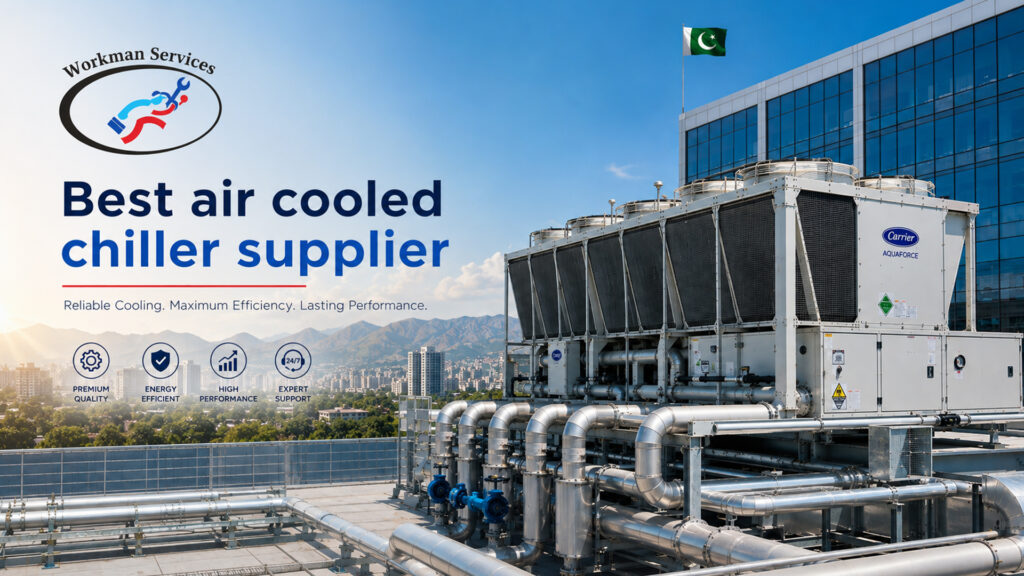
Air Cooled Chiller Supplier in Pakistan: Why Workman Services Is Your Best Choice Choosing the right cooling partner can make or break a project. Whether you run a hospital, a factory, or a growing office block, the equipment behind your comfort matters. That is where a trusted air cooled chiller supplier steps in to guide you from design to daily operation. Workman Services has delivered advanced HVAC&R and fire fighting solutions since 2006. Based in Lahore, Pakistan, we help clients across the country and the UAE keep their spaces cool, safe, and efficient. This guide explains how air cooled chillers work, why they suit so many buildings, and what to look for before you buy. What an Air Cooled Chiller Actually Does An air cooled chiller removes heat from water using fans and outdoor air, then sends that chilled water through your building to cool it. Unlike water cooled systems, it does not need a cooling tower or a constant water supply. That makes installation simpler and maintenance easier. These systems shine in places where water is limited or costly. They work well for commercial towers, industrial plants, hospitals, and large retail spaces. Because the unit sits outdoors, it also frees up valuable indoor room. Air cooled chillers pair naturally with other equipment. Many buildings combine them with Air Handling Units and Fan Coil Units to move cooled air where it is needed most. A knowledgeable Hvac System Provider can design this full loop so every zone stays comfortable. Choosing the Right Air Cooled Chiller Supplier for Your Project Not every vendor offers the same value. Some only sell hardware and walk away. The best partners handle the whole journey: design, supply, installation, testing, commissioning, and long-term care. When you evaluate an air cooled chiller supplier, look at experience first. A company with nearly two decades of field work understands local climate, power conditions, and building codes. Workman Services brings that depth to every project we take on. Also check the brand range. We work with top names such as Midea, Gree, Hitachi, Acson, and more. This lets us match the exact model to your load, budget, and energy goals rather than pushing a single product. The Value of a Certified Air Cooled Chiller Supplier and Service Team Buying equipment is only half the story. Installation quality decides how long your system lasts and how much it costs to run. A certified team commissions each unit correctly, so you avoid early breakdowns and wasted energy. An experienced air cooled chiller supplier also supports you after handover. Scheduled maintenance keeps performance high and warranties valid. Our engineers, sales specialists, and technicians stay available across Lahore, Rawalpindi, Faisalabad, and the UAE. Comparing Cooling Systems: Which One Fits You? Different buildings need different solutions. The table below compares common options we design and install, so you can see where each one performs best. System Type Best For Water Needed Install Complexity Ideal Sectors Air Cooled Chiller Medium to large buildings No Moderate Commercial, Industrial, Hospitals Water Cooled Chiller Very large facilities Yes High Large Industrial, Malls VRF System Multi-zone control No Moderate Offices, Hotels, Retail AHU + Ducting Fresh air distribution No Moderate Hospitals, Cleanrooms FCU Room-level comfort No Low Apartments, Small Offices Central Ac unit Whole-building cooling Varies Moderate to High Commercial, Residential A Central Ac unit works well when you want steady, even cooling across an entire property from one source. It reduces the clutter of many small units and simplifies control. For flexible zoning, a VRF system often wins because it adjusts output room by room. As a full Hvac System Provider, we help you weigh these choices against your real needs, not a sales script. Sectors We Serve Across Pakistan and the UAE Cooling needs vary widely by industry. Our team tailors each design to the exact demands of the space and its users. Residential: Apartments and luxury villas that need quiet, efficient comfort. Commercial: Office spaces, IT companies, and automotive showrooms. Industrial: Manufacturing units that require stable temperatures for processes. Hospitals: Clean, reliable air quality for patient safety. Offices: Balanced zoning for productivity and low running costs. Retail: Consistent comfort that keeps shoppers browsing longer. Each sector benefits from a partner who understands both the equipment and the environment. A dependable air cooled chiller dealer can recommend the right tonnage and configuration for these varied loads. Full HVAC and Fire Fighting Solutions Under One Roof Cooling is only part of a safe, comfortable building. Workman Services delivers a complete package so you deal with one trusted team instead of many vendors. Our HVAC services include: Chillers for industrial and commercial cooling VRF systems for smart, multi-zone control AHU units for air quality and temperature balance FCU units for room-level comfort Ducting for clean, even air distribution We also provide fire fighting supply and installation. This covers fire safety consultation, suppression systems, alarm systems, and evacuation planning. Pairing cooling and safety in one contract saves time and reduces coordination headaches. Working with a single air cooled chiller distributor for both comfort and safety gives you clearer accountability. If a question arises, you have one point of contact who knows your building inside out. Why Workman Services Stands Out Clients return to us because we deliver on our promises. We only stock quality brands, so your system performs and lasts. Our technicians arrive on time and finish the job properly the first time. We also focus on long-term value. Efficient equipment and expert installation cut your energy bills and reduce costly repairs. As a leading air cooled chiller distributor, we back every project with responsive support and honest advice. Our reach matters too. With branches in Lahore, Rawalpindi, Faisalabad, and Abu Dhabi, we serve a wide client base quickly. That local presence means faster service calls and shorter downtime for you. Being a respected air cooled chiller dealer is about trust as much as technology. We build that trust through clear communication, fair pricing, and reliable results on every
Air Cooled Chiller Guide: Types, Uses & Best Supplier
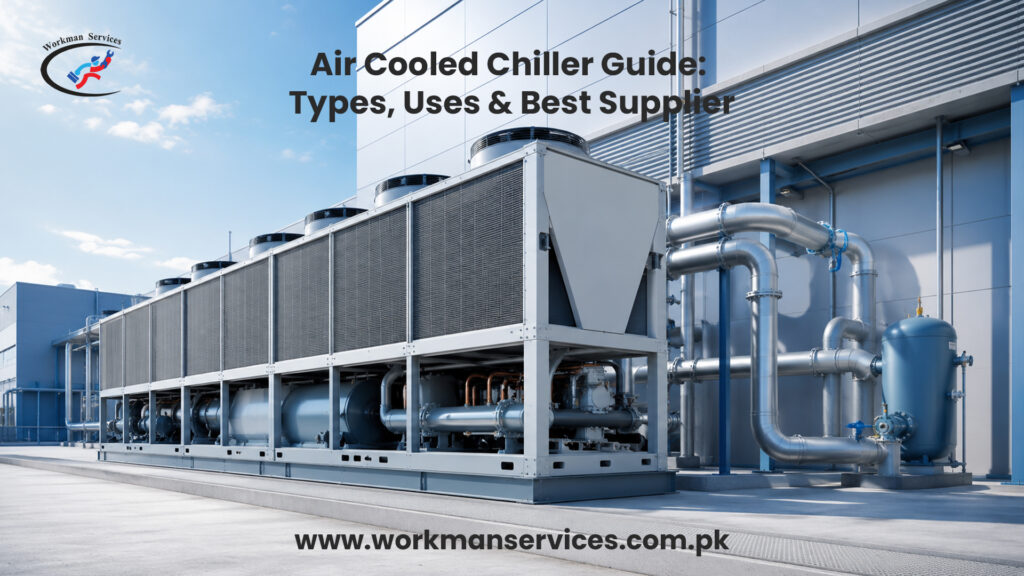
Air Cooled Chiller Guide: Types, Uses & Best Supplier Picture a busy factory floor in Lahore during peak summer. Machines run hot, workers sweat, and production slows. The fix? Reliable cooling that never quits. That’s where an air cooled chiller earns its keep. It pulls heat out of your process or building and dumps it into the surrounding air, keeping temperatures steady without the fuss of a water tower. If you manage a plant, a shopping mall, an office, or a hospital, this guide is for you. You’ll learn what these systems are, how the different types work, and how to pick the right one. We’ll also compare top brands and show you why Workman Services is the supplier businesses across Pakistan trust. Let’s get into it. What Is an Air Cooled Chiller? An air cooled chiller is a refrigeration machine that removes heat from water or another fluid and releases that heat into the air using fans. Unlike water-cooled models, it does not need a cooling tower or a constant water supply. That makes it simpler to install and cheaper to maintain. Here’s how it works in plain terms: A compressor pressurizes refrigerant. The refrigerant absorbs heat from the circulating water. Fans blow ambient air across a condenser coil to release that heat outdoors. The cooled water flows back to your building or equipment. Because everything runs on air, you skip the water bills, the treatment chemicals, and the tower upkeep. That simplicity is why so many facilities in Pakistan choose this option. It works well in dry climates and locations where water is scarce or expensive. Quick takeaway: If you want dependable cooling with low water use and easy servicing, this technology is hard to beat. What Is an Industrial Air Cooled Chiller? An industrial air cooled chiller is a heavy-duty version built for factories, manufacturing lines, and process cooling. These units handle large heat loads and run around the clock. Think plastics, pharmaceuticals, food processing, and metal fabrication. What sets an industrial air cooled chiller apart: Higher capacity: Sized in hundreds of tons for demanding loads. Rugged build: Made to survive dust, vibration, and nonstop operation. Precise control: Holds tight temperature ranges that sensitive processes require. Downtime in a factory costs real money. A well-matched industrial air cooled chiller keeps your process temperatures stable, protects your equipment, and reduces the risk of spoiled batches. For plants in cities like Faisalabad and Karachi, this reliability is everything. What Is a Commercial Air Cooled Chiller? A commercial air cooled chiller cools larger buildings such as malls, hotels, hospitals, and office towers. Instead of one process line, it serves an entire space through air handling units and fan coils. A commercial air cooled chiller usually offers: Comfort cooling for many rooms and floors at once. Energy management features that cut running costs. Quiet operation suited to guest-facing spaces. Say you run a hotel in Islamabad. Guests expect cool, comfortable rooms year-round. A properly sized commercial air cooled chiller delivers that comfort while keeping your energy bills in check. It scales with your building and adapts as your cooling needs change through the seasons. What Is an Air Cooled Chiller System? An air cooled chiller system is the complete setup, not just the box outside. It includes the chiller, pumps, piping, air handling units, controls, and sensors all working together. The main parts of an air cooled chiller system are: The chiller that produces chilled water. Pumps that move the water through the loop. Air handlers or fan coils that deliver cooling to rooms. Controls that manage temperature and efficiency. Why does the full picture matter? Because performance depends on the whole loop, not one part. A great chiller paired with undersized pumps or poor controls will disappoint. A properly designed air cooled chiller system balances every component so you get steady comfort and lower energy use. Quick takeaway: Buy the system, not just the unit. Design and integration decide your long-term results. What Is an Air Cooled Chiller Unit? An air cooled chiller unit is the physical machine itself, the packaged equipment containing the compressor, condenser coils, fans, and controls. It’s what sits on your roof or beside your building. Key features of a modern air cooled chiller unit: Compact, packaged design for straightforward installation. Multiple compressors for backup and part-load efficiency. Weatherproof housing built for outdoor placement. When you compare an air cooled chiller unit from different brands, look at efficiency ratings, sound levels, footprint, and warranty. A slightly higher upfront cost often pays back through lower energy bills. Choosing the right air cooled chiller unit for your load is the single biggest factor in long-term savings. Chiller Types and Brand Comparison Table Use this quick comparison to match the right solution to your needs. Type / Brand Best For Typical Capacity Key Benefit Industrial chiller Factories, process cooling Medium to very high (100+ TR) Rugged, precise, 24/7 duty Commercial chiller Malls, hotels, hospitals, offices Medium to high Comfort cooling, energy savings Carrier Premium commercial & industrial use Wide range Global brand, proven reliability Euroklimat Custom & high-efficiency projects Wide range European engineering, flexible design Gradhvac Cost-effective commercial & industrial Wide range Strong value, dependable performance Each brand has its strengths. Carrier is a trusted global name. Euroklimat brings European precision and custom designs. Gradhvac offers solid performance at a competitive price. The best choice depends on your load, budget, and building type, and that’s where expert guidance pays off. Why Workman Services Is the Best Air Cooled Chiller Supplier in Pakistan Since 2006, Workman Services has delivered HVAC and cooling solutions across the country. When it comes to sourcing, installing, and maintaining chillers, few match their depth of experience. Here’s what makes them stand out: Top brands under one roof: They supply Carrier, Euroklimat, and Gradhvac, so you get the right fit for your project instead of a one-size-fits-all sale. Nationwide reach: They serve Lahore, Islamabad, Faisalabad, Karachi, and other cities of Pakistan, so support is always
Water Cooled Chiller Systems for Commercial Cooling in Pakistan
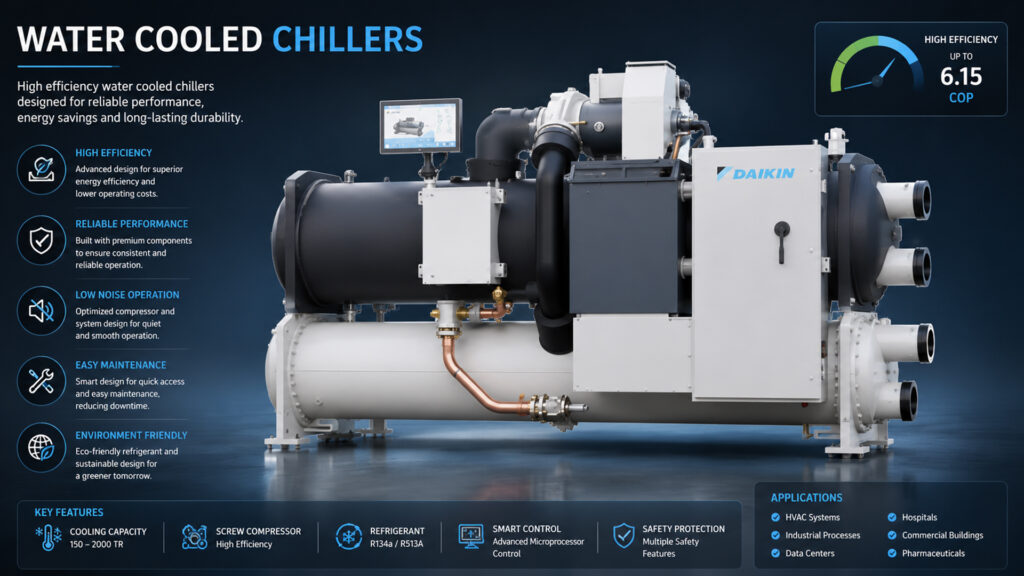
Water Cooled Chiller Systems for Commercial Cooling in Pakistan High-Level Summary A water cooled chiller is a strong choice for factories, malls, hospitals, offices, hotels, and other large buildings that need stable cooling performance. These systems are built for heavy-duty work, long operating hours, and better heat rejection in demanding commercial and industrial environments. For businesses in Pakistan, the right cooling setup is not only about temperature control. It also affects energy use, equipment life, downtime, and service costs. That is why buyers often compare system type, efficiency, maintenance needs, and long-term support before making a decision. This guide explains how these systems work, where they fit best, and what to look for before you buy. It also covers service support from workmanservices.com.pk, common buying questions, and practical comparison points for decision-makers who need reliable HVAC solutions. What Is a Water Cooled Chiller? A water cooled chiller is a central cooling system that removes heat from a building or industrial process through chilled water circulation and a water-based condenser loop. In simple terms, it cools water and sends that chilled water to air handling units, fan coil units, or process equipment across the site. Unlike air-cooled systems that release heat directly into outdoor air, these units reject heat through cooling towers and condenser water circulation. This design often makes them suitable for large-scale applications where cooling demand remains high for long periods. For many commercial sites, this setup offers better efficiency under continuous load. That matters in Pakistan, where large buildings often face high ambient temperatures and long summer seasons. Why Businesses in Pakistan Choose These Systems Large facilities need cooling systems that can handle pressure without sharp drops in performance. That is one reason a water cooled chiller remains a preferred option in many commercial and industrial projects. Better fit for heavy-duty operations These systems are often used where cooling demand stays high throughout the day. Hospitals, textile units, pharmaceutical plants, shopping centers, and office towers all need dependable cooling to support people, products, and equipment. Improved efficiency in larger applications In large-capacity projects, water-based heat rejection can perform more efficiently than many standard air-cooled alternatives. Lower operating costs over time can make a major difference for businesses with round-the-clock cooling needs. Longer service life with proper maintenance A well-maintained system can deliver strong long-term value. Routine inspections, correct water treatment, and professional servicing help reduce wear on major components and keep output more stable. How Workman Services Supports Commercial Cooling Projects workmanservices.com.pk serves businesses that need practical HVAC planning, supply support, installation guidance, and maintenance solutions across Pakistan. For commercial and industrial clients, this matters because system performance depends on more than the equipment alone. A project usually starts with site review, load assessment, and application planning. From there, the right model, capacity, and supporting components can be matched to the building or process requirement. That includes pumps, cooling towers, piping integration, controls, and service access. Businesses also need a dependable water cooled chiller supplier that understands real operating conditions in Pakistan. Workman Services focuses on commercial cooling needs where uptime, technical clarity, and after-sales support matter. Choosing a trusted water cooled chiller supplier helps reduce mistakes in equipment selection and improves long-term performance. Many project owners prefer a water cooled chiller supplier that can support both planning and service coordination. Key Applications in Pakistan These systems are widely used in projects where split units or small packaged solutions are not enough. Industrial facilities Manufacturing sites often need process cooling for production lines, machinery, and controlled environments. Stable chilled water supply helps protect output quality and equipment reliability. Commercial buildings Hotels, malls, offices, and mixed-use developments need comfort cooling for large occupancies. Centralized systems help manage temperature across wide floor areas more effectively. Healthcare and pharmaceuticals Hospitals and medical facilities rely on controlled indoor conditions for patient comfort and equipment operation. Pharmaceutical environments may also require stricter cooling stability. Institutional and infrastructure projects Airports, universities, and large public buildings often use centralized cooling because it supports scale, zoning, and easier load management. Service and Solution Factors Buyers Should Review Before investing, businesses should compare more than the initial equipment cost. A smart purchase looks at design quality, service readiness, and expansion needs. Capacity matching An undersized system will struggle. An oversized one may waste energy and increase capital cost. Proper load calculation is essential. Water quality and treatment Poor water conditions can reduce efficiency and damage heat exchange surfaces. Water treatment planning should always be part of the project. Maintenance access Technicians need room to inspect, clean, and repair the system. Good layout planning saves time and reduces future service issues. Spare parts and technical support A system is only as dependable as the support behind it. That is why buyers compare the water cooled chiller price along with service network strength, parts access, and response time. Looking only at water cooled chiller price can create problems later if technical backup is weak. A realistic review of water cooled chiller price should include installation scope, controls, accessories, and lifecycle cost. Technical Comparison Table Factor Water-Cooled System Air-Cooled System Why It Matters Heat Rejection Method Uses cooling tower and water loop Uses outdoor air Impacts efficiency and site design Best Use Case Large commercial and industrial projects Small to mid-size projects Helps match system to building need Energy Performance Often better at high load Can be less efficient in heavy use Affects long-term operating cost Space Requirement Needs plant room and cooling tower support Easier outdoor placement Important for planning Maintenance Need Higher due to water loop and treatment Lower relative complexity Impacts service schedule Noise at Main Unit Often lower indoors Can be higher outdoors Useful for site comfort planning Capital Complexity Higher initial system integration Simpler installation Affects budget and timeline Long-Term Value Strong for large-scale continuous use Good for smaller simpler sites Supports better buying decisions Related Cooling and Package Unit Support in Major Cities Some clients compare chiller systems with packaged equipment before finalizing